Full spoilers for #10 and #11. This visual analysis is limited to the directly reviewed two-part hunt, not every appearance across the entire series. Reviewed October 27, 2026.
Bigfoot imagery in The Department of Truth #10–11 shifts between handwritten recollection, sketches, cultural montage, threatening close-ups, and a body occupying the same space as the hunters. Those changes do not establish a single proven explanation for every difference in the creature's appearance. The pages support a more precise reading: Martin Simmonds varies the visual form according to the kind of scene and evidence the reader is encountering, while the dialogue supplies a fictional theory of unstable manifestations shaped by belief.
 Original AI-generated conceptual illustration. These are generic forest images, not reproduced comic panels, genuine Bigfoot evidence, or photographs of a canonical creature.
The first distinction: an image is not always a sighting
A Bigfoot image can play several roles in a comic. It may show an event in the present action. It may illustrate a character's recollection, decorate a document, condense a cultural history, or appear on a cover. A useful analysis identifies the role before treating the image as evidence of a creature's literal body.
That distinction is essential in these two issues because the visual presentation deliberately moves between modes. Evan's handwriting and sketches do not function like a detached camera. Hawk's lecture does not stay within the visual limits of three people walking through trees. The encounter near the end of #11 gives the reader a different kind of proximity from the earlier diagrams and remembered traces.
The result is a shifting experience of certainty. The reader can see more, yet the meaning of what is seen remains entangled with family memory, institutional interpretation, and the wish for proof. That is a critical reading of the sequence. It is not a documented creator statement about intention, and it should not be attributed to Simmonds or Tynion without a supporting interview.
This article uses the same locator convention as the companion case guide: story-image 1 is the first narrative image after the credits, and a spread stored as one image counts once. Source filename suffix 002 corresponds to story-image 1 in both supplied issues. These are reproducible image locators, not invented printed page numbers.
A visual map of the two issues
| Passage | Dominant visual mode | What can be observed | What should not be assumed |
|---|---|---|---|
| #10, story-image 6 | Chapter illustration and sketch vocabulary | A hairy figure and anatomical fragments accompany the chapter opening | A separate witnessed encounter |
| #10, images 7–9 | Handwritten memory and drawings | Footprints, bodily traces, and the father's remembered excitement | A complete objective reconstruction of childhood |
| #10, images 15–17 | Family testimony with visual fragments | Memory, loss, and the repeated effort to picture the experience | That every drawing records a different physical specimen |
| #11, images 3–7 | Expository montage | Creature forms, cultural references, and hunters arranged within expansive compositions | A literal simultaneous parade of monsters |
| #11, images 13–15 | Encounter close-ups and scale contrast | Eyes, faces, fur, teeth, and Evan's proximity to the creature | A measured anatomical model |
| #11, images 16–19 | Aftermath in shared space | The fallen body, the hunters, and Hawk's interaction with Evan | A complete disposal sequence or future outcome |
| #11, images 20–21 | Letter and family image | Private hopes and relationships regain the final emphasis | Proof that the feared or hoped-for future has occurred |
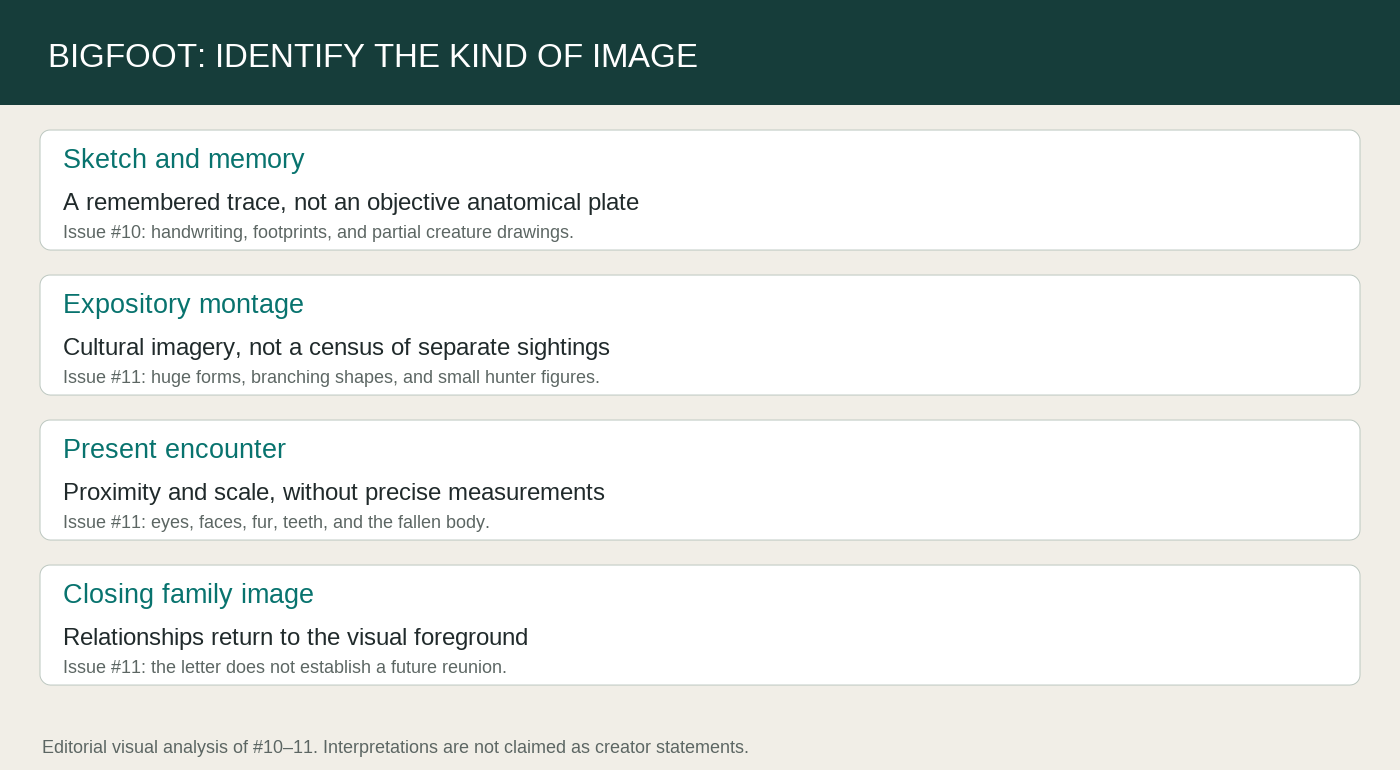 This is an analytical classification of presentation, not a taxonomy of different Bigfoot species.
Sketches make the creature something a person is trying to grasp
The chapter opening in #10 introduces a drawing vocabulary that continues through Evan's handwritten account. Parts of a creature, footprints, and searching lines sit beside words rather than forming one stable technical illustration. The reader sees an effort to remember and describe. The incompleteness is part of the experience. [#10, story-images 6–9.]
A sketch is particularly suited to this problem because it can be both evidence and an admission of uncertainty. It records what someone wants to retain, but the act of drawing does not guarantee that the memory is complete or accurate. Evan's verbal uncertainty reinforces that distinction. His recollection and the visual marks should be read together rather than making the image silently correct the narration.
This prevents a common overstatement in appearance guides. If two sketches differ, it does not follow that two independently verified creatures had different anatomy. The differences may arise from remembered fragments, expressive emphasis, or the visual design of the document. The comic's supernatural premise remains relevant, but it does not eliminate these ordinary differences between forms of representation.
For a panel comparison, describe the visible feature first. Is the image a face, footprint, hand, silhouette, or full figure? Is it embedded in handwriting or situated in a continuous scene? Only after answering those questions should an interpretation explain what the change might mean. This order makes the argument inspectable by another reader.
The footprint is powerful because it is a trace
In the childhood passage, the footprint carries the promise of a body without displaying that body in a clear, sustained encounter. Its scale and the father's reaction make it emotionally large. It seems to offer the possibility that something extraordinary has left a mark in an ordinary place. [#10, story-images 7–9.]
That is different from a portrait of a monster. A trace asks the viewer to infer an absent cause. Evan's account supplies sensations, excitement, and anticipated proof, but the footprint itself does not narrate the creature's whole history. The father's hope rushes ahead of what can be preserved and presented to others.
Rain then becomes important not merely as weather but as a threat to the hoped-for transition from private experience to public evidence. The letter remembers the possibility of showing the discovery beyond the family. Its loss helps explain why an incomplete image can acquire more power in memory rather than less.
The analysis should not turn that sequence into a real-world argument for Bigfoot. It is a fictional memory inside a comic whose premise allows belief to affect reality. The reader's task here is to understand how the footprint functions in Evan's story, not to promote it as biological evidence outside that story.
The family photographs offer a different kind of proof
The issues do not rely exclusively on cryptid imagery. Family images and faces supply another visual record of what Evan stands to lose. When the narrative returns to relatives, phone calls, and remembered conflict, the object of attention shifts from an elusive creature to relationships that already exist. [#10, story-images 10–12; #11, story-image 21.]
The contrast can be read as a challenge to Evan's priorities. He longs for an image or object that will justify decades of searching, while the story keeps showing people whose claims on him do not depend on a spectacular discovery. This is an interpretation of the arrangement, not a claim that the comic reduces his grief to a simple moral lesson.
The family images also keep the hunter from dissolving into a symbol. Evan is a father and son with a specific history. His search may illustrate a broader problem about belief, but the pages repeatedly restore the personal consequences. A visual guide that includes only the monster would miss much of the mechanism that makes its eventual appearance matter.
The ending returns to this human emphasis after the encounter. That placement is significant: the final emotional weight does not rest on an anatomical reveal or a catalog entry. It rests on what Evan wishes he could communicate to his family and on the limits of what the reader knows about the future.
The lecture montage expands beyond a camera's viewpoint
In #11, Hawk and Darla's discussion of wild creatures and cultural stories is accompanied by images much larger and more associative than a straightforward view of their walk. The hunters can appear small inside compositions dominated by creature imagery, branches, and circulating shapes. The page becomes an explanation space as well as a location. [#11, story-images 3–7.]
One expansive composition includes a huge central furry form with branching shapes above and around it. It would be too strong to cite that image alone as proof that the physically encountered Bigfoot has a fixed set of antlers. The picture appears within a lecture montage, where scale and juxtaposition organize ideas rather than simply record a zoological specimen. [#11, story-image 7; source image 008.]
This does not make the image irrelevant to the creature. It tells the reader something about how the story imagines the cultural weight surrounding it. A useful caption might describe the branching forms and the small hunters placed within the composition. An unsupported caption would label it an officially established alternate species or a definitive transformation stage.
The montage also brings real-world references into the fictional explanation. Their appearance shows which narratives the characters invoke. It does not independently verify every historical claim attached to them. A visual analysis can explain their role in the page while leaving historical fact-checking to a separately sourced discussion.
Repeated circles connect visual fields without explaining themselves
Concentric circular motifs recur across the imagery, including around faces, figures, and the handwritten conclusion. Their repetition creates continuity between passages that otherwise use different visual modes. They can draw attention to a face, crowd a surface, or make the surrounding space feel unsettled. [#11, story-images 13–21.]
There are several plausible ways to read that effect. The circles can evoke targeting, ripples, pressure, or overlapping fields of perception. Those are comparisons made by a reader. The pages checked here do not provide a legend declaring one exclusive meaning for the device. An article should therefore avoid turning an evocative visual analogy into a canonical mechanism.
In particular, the circles should not be labeled as a measurable aura, a guaranteed symptom, or a technical sensor display without direct evidence. A visual motif can operate across emotional and conceptual levels at once. Repetition establishes that it is part of the design; it does not by itself establish an in-world instrument or rule.
The strongest analysis connects the motif to a specific local effect. When it overlays the encounter, it complicates the apparent stability of what Evan sees. When it continues around handwriting, it links the physical event to the account of longing and fear. That reading remains open to alternatives while staying grounded in observable placements.
Close-ups change the question from classification to proximity
Near the encounter, the imagery concentrates on eyes, faces, fur, and teeth. Evan's glasses and expressions sit beside the creature's overwhelming presence. The issue is no longer only what kind of thing Bigfoot might be. It is what it feels like for this hunter to stand close to the thing he has pursued for decades. [#11, story-images 13–15.]
Scale is crucial to that shift. A small human figure beside a towering form communicates vulnerability without supplying a numerical height. The comic does not need a ruler to make the imbalance legible. Conversely, a guide should not derive a precise measurement from an expressive composition whose perspective and proportions serve dramatic effects.
The close-ups also frustrate the wish for a calm evidentiary photograph. A face filling the image can reveal texture and still withhold the stable distance needed for classification. More visual detail does not necessarily produce more usable certainty. In this reading, the presentation makes Evan's long-awaited proof emotionally overwhelming before it can become an orderly claim.
That effect should not be confused with a statement that the encounter is merely imaginary. The subsequent shared scene includes the other hunters and the fallen body. The article can acknowledge the event's placement in present action while still analyzing the expressive instability of the images through which readers experience it.
Dialogue supplies a theory, but the art does not prove every part
In #10, Darla and Hawk explain wild fictions through belief, persistence, unstable reality, and the difficulty of producing clear photographs. Those claims create an in-world framework for reading the visual treatment. They make it reasonable to consider a relationship between the creature's instability and the appearance of the pages. [#10, story-images 20–23.]
The careful phrasing is that the visual treatment is consistent with, or can be read alongside, their explanation. It is stronger than the evidence warrants to say every brushstroke proves the same supernatural law. The art also depicts memories, emotional states, and cultural montage. Those modes can be expressive without each representing a literal change in the creature's body.
Nor do the two issues establish a universal rule that Bigfoot looks exactly like whatever a particular observer expects at each instant. That proposed mechanism would require a more specific comparison: the observer's stated expectation, the shown change, and a causal connection confirmed by the story. The reviewed scenes do not supply that complete chain for every variation.
This distinction preserves the comic's ambiguity instead of reducing it. The reader has a theory voiced by knowledgeable but interested characters and a series of images that make uncertainty tangible. Treating the theory as a complete technical manual would erase the very gap between explanation and experience that the pages invite readers to consider.
The body in the aftermath changes the visual relationship
After the creature is brought down, the hunters and Evan occupy a scene with its body. That gives the encounter a shared aftermath. The body can be pointed to, stood beside, and discussed as something requiring disposal. The visual relationship differs from the earlier remembered footprint and from the huge forms in the lecture montage. [#11, story-images 16–19.]
Yet the story does not turn this moment into a neat scientific plate. The attention moves toward Hawk's response to Evan. A man who has spent fifty years searching receives reassurance and permission to leave. The extraordinary body remains present, but human contact becomes central to the scene's meaning.
Hawk's later disposal instruction restores the institutional frame. What Evan wants to make public is treated by the Department as material to remove. The image of the body and the order to cut it up and burn it bring containment into view. They do not establish that every step is completed during the pages shown.
The scene therefore supports two observations at once. The creature is part of the depicted operation's physical aftermath, and its evidentiary future is controlled by people with an interest in preventing public proof. That is a statement about this fictional case, not an endorsement of comparable claims about real authorities or real cryptids.
Covers and promotional images need separate labels
The cover of #11 uses a highly stylized creature image and surrounding symbolic design. It belongs in a cover discussion, but it should not automatically be entered into a chronology as a separate event. Covers can condense themes, create anticipation, or offer a composition that does not correspond to one interior moment.
The same principle applies to variant covers. A different artist's portrayal can be a valuable artistic comparison without establishing a canonical transformation. Before making an appearance table, label the source as interior action, interior document, cover, variant, or promotional image. That small distinction prevents very different kinds of images from being counted as equivalent sightings.
This article does not attempt a variant-cover census. The official records for #10 and #11 can support issue and cover-credit checks, but a complete visual comparison requires identifying and inspecting each selected image. Do not expand this two-issue analysis into an all-series claim merely because other art is readily searchable.
How to compare a later appearance responsibly
Begin by recording the issue, the scene, and the visual mode. Then describe the apparent difference in ordinary terms: silhouette, face, scale, texture, color, or surrounding motifs. Keep the description distinct from its proposed cause. Another reader should be able to agree with the description even if they interpret the cause differently.
Next, identify whose perspective organizes the scene. A recollection, a field report, and a present encounter can each provide useful evidence, but they have different limits. Ask whether dialogue explicitly comments on a change or whether the difference is something the reader notices. The answer determines how confidently a guide can describe an in-world transformation.
Finally, compare the actual passages rather than a cropped image detached from its sequence. The neighboring text may identify a speaker, reveal that an image is illustrative, or change the time frame. A strong appearance guide preserves that context in its caption and source note. It does not need to reproduce entire pages to make the comparison precise.
Frequently asked questions
Why does Bigfoot look different across these pages?
The images serve different narrative functions, including memory, sketch, montage, and present action. The characters also describe unstable manifestations shaped by belief. The reviewed issues do not establish one exclusive cause for every visual variation.
Is every drawing a separate Bigfoot sighting?
No. A sketch or montage image is not automatically an independently witnessed event. Identify the source's role before adding it to a case chronology.
Do the branching forms prove Bigfoot has antlers?
The prominent branching composition occurs within an explanatory montage in #11. It supports a description of that image, not a universal anatomical claim about the creature encountered later.
Does the blurry style mean the encounter is unreal?
That conclusion is not established. The sequence proceeds into a shared aftermath with the hunters and a fallen body. Expressive presentation and the fictional event's status should be considered separately.
Can this article explain every Bigfoot image in the series?
No. Its evidence cutoff is #10–11. A broader guide needs direct inspection and citations for later issues, case-file entries, and any covers it chooses to include.
Sources and further reading
Primary visual and textual evidence: The Department of Truth #10 and #11, written by James Tynion IV, art by Martin Simmonds, lettering by Aditya Bidikar, directly reviewed in the supplied copies. Image Comics issue records establish publication metadata. Use the companion case chronology for the plot sequence and the existing Bigfoot page for a quick case reference. Interpretations in this article are editorial analysis, not attributed creator intent.