Reviewed October 28, 2026. Full spoilers for #1 and #2 only. This article explains the opening model of reality without using later revelations to settle its uncertainties.
Consensus reality is the series' idea that shared belief can acquire material force and change the world people inhabit. In #1, Lee Harvey Oswald explains Cole Turner's impossible experience as a competing reality beginning to take hold. In #2, Ruby emphasizes that familiar conspiracy stories can be contingent rather than permanently true or false. These explanations give Cole a framework, but the opening issues do not make every part of that framework equally proven. They distinguish an extraordinary experience, an institution's explanation, and the larger claims people want that experience to justify.
 Original AI-generated conceptual illustration about competing views. It is not a comic scene, a Department location, or evidence of altered reality.
Why “every conspiracy is true” is an incomplete reading
The first issue's publisher description offers a broad promotional hook about conspiracy theories becoming true. The actual closing conversation is more specific. Lee tells Cole that the Earth is round while describing Cole's Antarctic experience as another kind of truth taking hold. He does not simply replace ordinary geography with a permanent flat-Earth revelation. [#1, source images 025–026.]
That difference matters because the premise concerns change, competition, and causation. A story might acquire effects without having been historically correct from the beginning. If the reader treats every conspiracy as an eternal hidden fact, the Department becomes an organization concealing a fixed catalog of secrets. Lee instead describes an organization trying to prevent beliefs from changing the conditions under which truth is established.
The promotional description and the dialogue have different jobs. The former attracts readers; the latter begins defining a fictional system. For a precise explanation, the scene should control the wording. A premise can be summarized vividly without turning that summary into a universal rule that the pages never actually state.
The real-world boundary is equally clear: this is a supernatural premise in a work of fiction. Its use of recognizable claims about the Moon landing, the shape of Earth, or political figures does not provide evidence for those claims outside the story. This article analyzes how the comic uses them, not whether the fictional events validate them.
How the source references work
The primary evidence is the supplied digital reference copies of The Department of Truth #1 and #2. Citations use the three-digit suffix of the source image filename. For example, #1 image 026 means The Department of Truth 001-026.jpg; #2 image 014 means Department of Truth 002-014.jpg. These are file locators, not assertions about printed page numbers. Scene descriptions accompany them so readers using collections can find the same material.
Both issues are written by James Tynion IV, with art by Martin Simmonds and lettering by Aditya Bidikar. Image Comics dates #1 to September 30, 2020 and #2 to October 28, 2020. Those publication dates do not assign an exact year to every sequence marked as the story's present.
Three evidence labels guide the reading. Depicted experience means what the narrative shows a character encountering. Attributed explanation means what a speaker says about that experience or the world's rules. Interpretation means a conclusion drawn by the article from the arrangement of scenes. The labels are useful because the comic repeatedly places persuasive explanations beside incomplete information.
The Antarctic experience establishes a problem before it supplies a theory
Cole describes attending a flat-Earth gathering, meeting wealthy backers, watching an extraordinary film, and traveling with them. The sequence is embedded in his account to the people questioning him. He warns them that he has been drinking, has slept badly, and does not trust his memories. The story therefore introduces the experience together with Cole's uncertainty about how to report it. [#1, images 011–023.]
The film appears to show something inconsistent with the familiar Moon-landing account. The subsequent flight leads to the immense icy boundary depicted outside the aircraft. These images are dramatically forceful, but their role is not to settle the entire history of space travel or geography in one stroke. They establish the experience for which Cole needs an explanation.
His hosts supply one account: they have obtained hidden proof and intend to reveal something larger. Lee later supplies another: their activity has helped a competing reality begin manifesting. The same experience is therefore placed inside different causal stories. Readers should not erase that contest by describing the hosts' explanation as an objective narration of the world.
Cole's hesitation also matters. He does not arrive with a clean theory and then observe an uncomplicated confirmation. He is frightened, disoriented, and trying to separate what he saw from what he can responsibly claim. His position teaches the reader to ask how an event is being interpreted, not merely whether a striking image appears on the page.
What Lee actually says about collective belief
Lee's explanation has a clear direction: increasing belief makes a proposition more real and pushes reality toward that belief. He applies that model to the group Cole traveled with, saying their efforts produced the Antarctic manifestation. He then describes what could have followed if they had brought their proof back and spread it widely. [#1, image 026.]
This is the central opening doctrine. It links belief, material conditions, evidence, and further circulation. A manifestation could provide apparent confirmation that persuades additional people, allowing the rival account to gain more force. The danger is not simply that people hold incorrect opinions. In the fictional model, the world itself can begin to conform to them.
The page does not, however, provide a count of believers or a measured threshold. It also does not specify that each person's belief contributes an equal amount. “More belief increases the pressure” is a directional proposition. It is not a mathematical formula from which readers can calculate the number of participants required for a particular result.
Nor should a guide turn Lee's confidence into proof of perfect knowledge. He is explaining why his organization exists and why it wants Cole. The speech is both instruction and institutional self-justification. That does not make it automatically false; it makes attribution essential when moving from the scene to a general statement about canon.
Present manifestation and rewritten history are separate claims
One of the most consequential parts of Lee's account is retroactivity. He says that a sufficiently successful change would not leave everyone calmly remembering that the world used to be different. In the scenario he describes, the altered condition would acquire a history, and institutions would be understood as having concealed it all along. [#1, image 026.]
The opening case supports two different levels of discussion. Cole's reported journey supplies the extraordinary experience. Lee's hypothetical aftermath supplies the broader claim about historical revision. The issue does not show that full hypothetical aftermath happening to the entire world. A precise guide should not state that the Earth has already become permanently flat everywhere by the end of #1.
This distinction helps with many reader questions. “Can reality change?” and “Does every change rewrite all history?” are not identical. The first two issues introduce the possibility of large consequences but do not give a complete map of scope, timing, or exceptions. A local or limited manifestation cannot automatically prove every global implication attached to it.
It also explains why evidence becomes complicated. If a changed world can generate a different historical account, an apparently persuasive record may need to be situated within the change rather than treated as a transparent window onto an untouched past. That is an implication of Lee's theory, not an invitation to dismiss every document indiscriminately.
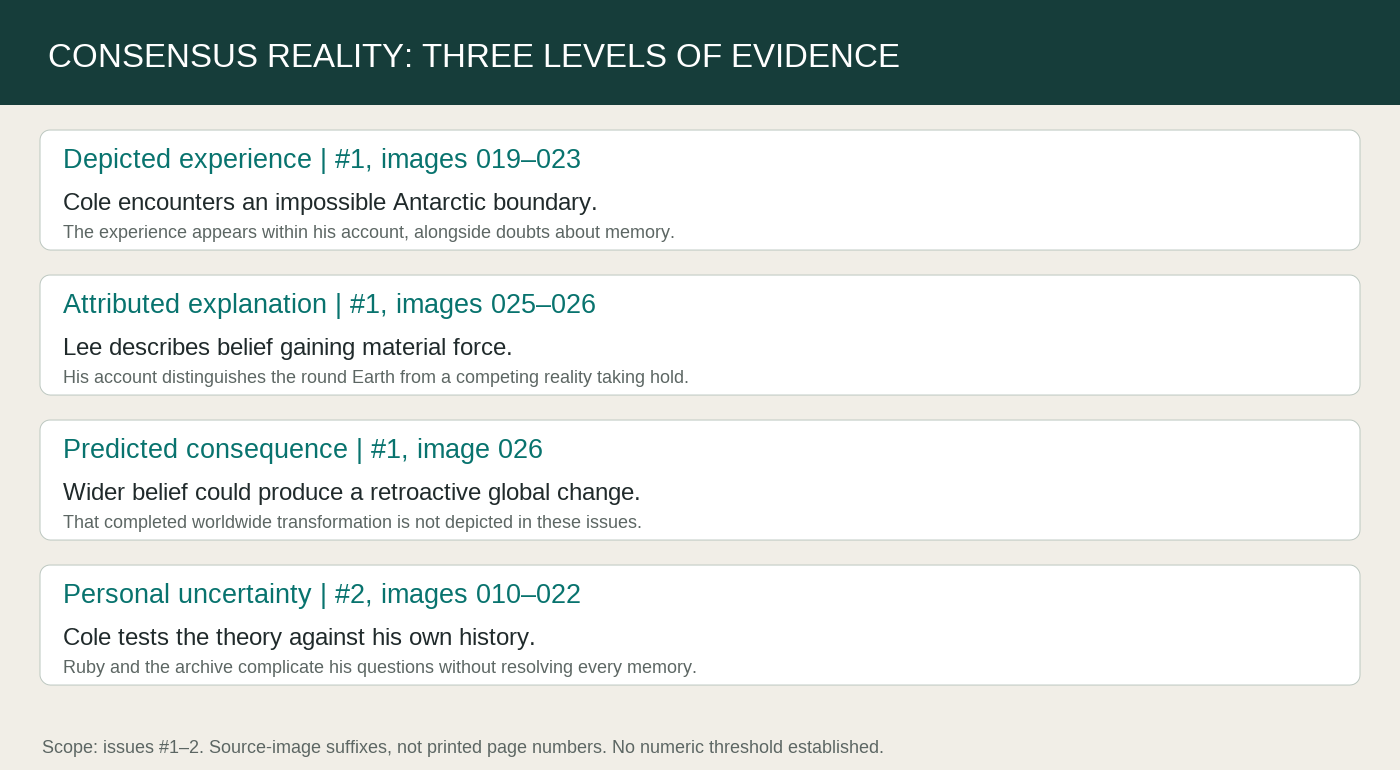 The Antarctic experience and Lee's projected worldwide revision are different evidentiary steps. The diagram does not claim that the projected outcome occurs in #1.
A compact rule-and-evidence table
| Opening proposition | Supporting passage | Evidence status at this cutoff |
|---|---|---|
| Cole experiences something incompatible with his ordinary expectations | #1, images 016–023 | Depicted through his account, with explicit memory doubts |
| Belief can push reality toward a proposition | Lee's explanation, #1 image 026 | Stated in-universe doctrine |
| The Antarctic event is a competing reality taking hold | Lee's explanation, #1 images 025–026 | Institutional interpretation of the case |
| A wider victory could revise history retroactively | Lee's hypothetical, #1 image 026 | Projected consequence, not a completed global outcome shown here |
| Familiar conspiracy forms can be contingent | Ruby's diner discussion, #2 image 010 | Attributed explanation, not a demonstrated inventory |
| Cole's childhood image has a disturbing later counterpart in the archive | #2, images 019–022 | Depicted recognition and document encounter; origin unresolved |
The table deliberately avoids giving every row the same label. An explanation may be the best working account available to the characters while still exceeding what the local scene independently demonstrates. The uncertainty is not an accidental defect in the evidence; it is one of the conditions under which Cole must act.
What the tulpa discussion does, and does not, settle
Cole reaches for the term “tulpa” while trying to understand the scale of what happened. He explains it as a thought form, a belief given a body. Lee accepts part of the comparison but says Cole is missing the scale. The exchange uses an individual-form concept to move toward a much larger question about the conditions of reality. [#1, image 025.]
This does not establish a neat hierarchy in which every phenomenon has one permanent label. The purpose of the exchange is explanatory: Cole offers a concept he knows, and Lee pushes him to think beyond a single embodied thing. A glossary should preserve that movement rather than treating the dialogue as a complete scientific classification system.
Lee's jokes and Ruby's corrections also keep the scene tied to particular voices. The speakers are not interchangeable mouthpieces delivering a single polished textbook. Their tone, impatience, and familiarity tell readers something about the institutional environment in which the theory is being taught.
For a new reader, the practical takeaway is that the opening premise includes both forms that can be encountered and wider conditions that might change. The comic's vocabulary helps characters discuss those possibilities, but the first two issues do not fully standardize every term or prove that every later anomaly will fit the same explanation.
Ruby makes contingency part of the model
At the diner in #2, Cole tries to turn the new premise into answers about familiar conspiracies. Ruby responds in a way that complicates a simple true-or-false checklist. Her remarks suggest that some things may exist, may have existed, or may vary with the cultural stories circulating around them. [#2, image 010.]
The important point is the conditional nature of the answer. The existence of a familiar conspiracy image in public culture does not necessarily correspond to one stable secret waiting to be uncovered. Under the model they are discussing, the image can participate in producing the thing people expect to find.
The scene also shows the limit of Cole's intellectual adjustment. He can say that he understands the broad concept while still seeking specific answers about Lee's identity and his own past. Understanding a theory does not remove the emotional need for a stable answer to a personal question. [#2, images 010–014.]
Ruby's comments should not be turned into a verified list of every extraordinary being she names. The diner conversation is testimony and explanation. It is valuable evidence about the Department's outlook, but it does not depict all the cases implied by that outlook.
The personal test: memory and the Star-Faced Man
The second issue connects the theory to Cole's childhood. He describes distressing memories associated with the Satanic Panic, explains that he has retained transcripts, and distinguishes what he remembers from what he knows he said. The difference matters: memory, testimony, and the historical event being alleged are not automatically the same object. [#2, images 012–014.]
Before his recruitment, Cole could use an ordinary explanation for the images that troubled him. The Department's model makes that reassurance less secure. He now needs to know whether a remembered figure can have some present reality without every allegation from the past becoming true. The comic makes the theoretical question urgent by attaching it to his life.
In the archive, he recognizes a figure in material Doc says is from the previous year. He requests related interview records, and the sequence introduces another child's account with imagery connected to the woman in red. Cole becomes overwhelmed. The issue ends before the origin and full relationship of these pieces are resolved. [#2, images 019–022.]
A careful conclusion is that the archive supplies a disturbing connection requiring investigation. It is not that every detail of Cole's childhood testimony has been authenticated. Nor is his distress evidence that he has solved the mechanism. The scene intensifies the problem rather than closing it.
Why the Department's explanation is also a claim to authority
At the end of #1, the organization tells Cole that he now works for it. Its explanation of reality arrives alongside an assertion of control over his employment and a description of its mission. The theory is therefore not being presented in a neutral classroom. It is part of recruitment. [#1, images 024–028.]
Lee and Ruby frame the Department as preventing conspiracy theories from becoming reality. That is the organization's stated purpose at this stage. The reader can understand the danger they describe while still asking who authorizes their interventions and how they decide which world should be preserved.
The Antarctic sequence already makes that question uncomfortable because Ruby's intervention includes lethal violence. The organization later explains the stakes, but explanation is not the same as independent moral justification. A capability to affect reality does not automatically grant an institution unlimited authority over witnesses, records, or rival accounts.
This is why consensus reality is more than a supernatural device. It puts the production of knowledge and the exercise of power in the same frame. Cole needs help understanding what happened, but accepting help also brings him within an organization that controls access to explanations. The two issues establish that dependency without resolving its long-term meaning.
The opening does not erase ordinary judgment
It would be a mistake to conclude that the premise makes every distinction meaningless. Cole still asks whether an account is reliable. He still notices uncertainty, seeks records, and asks who is speaking. Ruby still withholds information. Doc still maintains an archive and answers questions about dates. The characters act as though distinctions among sources matter, even in a world where those sources may be affected by belief.
The useful reading practice is therefore more careful comparison, not total surrender. Ask whether a passage is a reported memory, an institutional explanation, a visible action, or a document inside the fiction. Ask what the passage actually establishes before using it to settle a broader question. The series rewards attention to those differences from its beginning.
The same discipline prevents unsupported claims about creator intention. It is reasonable to analyze the relationship between uncertainty and authority in these scenes. It is a different claim to say the creators intended one precise real-world allegory or endorsed a character's politics. Such claims would need an interview or other direct evidence beyond the pages considered here.
Questions left open after #2
The first two issues do not provide a universal belief threshold, a complete account of how conflicting realities coexist, or a reliable procedure for reversing every change. They do not resolve which version of every historical figure is present, the woman in red's full role, or the origin of the figure troubling Cole.
They also leave a distinction between understanding the general premise and trusting an institution's complete account. Cole has received an explanation powerful enough to reorganize his questions. He has not received final answers to all of them. The continuation begins from that gap.
For readers who want to preserve the opening's uncertainty, stop this guide at its stated cutoff. Later cases may add evidence, but they should be introduced with their own issue references and spoiler markers. A retrospective answer can be useful without pretending that the answer was already available to Cole in the opening diner conversation.
Frequently asked questions
Is the Earth permanently flat in the comic after #1?
That is not what the closing explanation says. Lee affirms a round Earth and describes the Antarctic experience as a rival truth taking hold. His account of worldwide retroactive change is a projected consequence, not a completed outcome shown in that issue.
Does consensus mean everyone has to agree?
The opening issues do not require unanimous agreement or state an exact percentage. Lee describes increasing belief and a struggle over which account takes hold, without providing a numerical formula.
Does a manifestation prove the original story was always true?
Not automatically. The comic separates the possibility of a belief gaining material force from the historical accuracy of the account that preceded it. Lee's retroactivity claim makes that distinction especially consequential.
Does #2 prove all of Cole's childhood testimony?
No. It depicts disturbing connections in the archive and Cole's response, but it does not authenticate every alleged event or fully resolve the figure's origin at this cutoff.
Can Lee and Ruby's explanations be cited as canon?
They can be cited accurately as explanations those characters give. A guide should distinguish the occurrence of the statement from independent proof of every proposition inside it.
Sources and further reading
Primary sources: The Department of Truth #1 and #2, supplied reference copies reviewed directly. Image Comics issue records linked above supply publication metadata and creator credits. The source-image convention is defined near the beginning of the article.
For the wider series, see the Consensus Reality reference, How Reality Works, and Belief and Manifestation. This article stays with the opening two issues.